Thursday, April 9, 2015

Q & A with Joe Moore | Author of the SANTA CLAUS TRILOGY & RETURN OF THE BIRDS

Joe Moore (left) pictured with his wife, Mary.
Joe Moore is not only a novelist and children's writer, he is also a magazine feature writer, former business editor and a professional Santa Claus in the latter part of the year. Having such a diverse background enables Joe to write on a variety of subjects.

Literary Juice: Your life seems to be brimming with Christmas magic! Not only are you the author of the Santa Claus Trilogy and Santa’s Elf Series at The North Pole Press, but you have been a professional Santa Claus for over a decade as well. What is it about Christmas that has shaped who you are today? Also, how has your experience as a professional Santa Claus influenced your writing?  

Joe Moore: To say Christmas has shaped my life is an understatement. It began when my wife and I were building the North Pole from porcelain houses and miniatures. What began as a quaint village sprung up into a huge display with four different “sections” of the North Pole each with its own theme (think Disneyland). What took place shortly after was numerous open houses to see this spectacle and then the transition to me as Santa Claus in order to give “the tour”.

Once I started down that path there was no returning. As my wife, Mary (yes we are Mary and Joseph), and I developed our Santa and Mrs. Claus personalities, I also began writing about the North Pole and the events that took place there. While I have deviated from that theme in my last novel, I still spend the bulk of my time there.

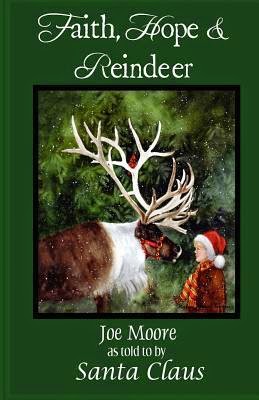
LJ: On your LinkedIn page, you wrote of your 2011 Christmas story, Faith, Hope & Reindeer, “Not since Miracle on 34th Street has there been such a vital storyline for the holidays.” What do you feel is missing in most modern Christmas stories? How does Faith, Hope & Reindeer fulfill what other holiday stories lack?   

JM: While there have been some really great Christmas movies produced on both the big and small screens, this story lines contains all the magic, all the belief and the hope that represents Christmas bundled into one beautifully wrapped gift. We all lose faith and hope from time to time, and many of us will see ourselves in the characters of this story.

What Faith, Hope & Reindeer shows is that we are rarely ever alone in our journey, and that magic and miracles are all around us if we only will open our eyes and hearts.

LJ: What does your writing process look like? For instance, when working on stories with a Christmas theme, do you employ any techniques that help you keep the holiday spirit alive, even after the season has ended?

JM: The season never really ends for me. Because I keep my beard and long hair all year (along with my large frame), whether it is April or August, I am always stopped by children and adults alike. What is wonderful is that this always affords me the opportunity to bring my characters out of the closet and parade them in front of my audience.

Many of my elves and their responsibilities began from talking to children and answering their questions about me, Mrs, Claus, the reindeer and the elves. When you can live your story lines, there is no better muse.

LJ: On a different note, you have been working on novels of a different flavor. Return of the Birds and The Chindi River venture from the Christmas nature for which you are known, and enter a realm of horror and suspense. Can you tell us a little more about these books? What was it like to make the transition from writing about holiday cheer to stories that are dark and suspenseful in nature?  

JM: Light and dark exist in every one of us. One of the biggest personal challenges I have is that if mood is not great, I cannot leave the house for fear it may show to children or anyone else expecting to see Santa Claus.

By writing in a darker genre, I am able to release some of those dark tendencies and take on a completely separate personality. Think of Stephen King's The Dark Half, without the physical acting out. It is a great cleansing of the soul to be able to write both genres.

LJ: We couldn’t help but notice Mrs. Claus is always right at your side! We are certain our readers would also love to hear about her as well! Are there any projects or stories she is working on?                  

JM: Without Mrs, Claus, there would be no Santa – at least in this Jolly Old Elf's case. In addition to supporting and playing a starring role in every thing we do as Santa and Mrs. Mary designs my covers, illustrates the children's books, formats and publishes the novels,  is my main sounding board, and of course is my first critic and editor. She was there in the beginning helping me build and shape the North Pole (and subsequently my ideas for the novels), and she continues to help me with new story ideas and developing each new character for the Santa's Elf Series.

She is as much a part of everything I do as joy is a part of Christmas.


Fiction by Joe Moore
Publisher: North Pole Press
ISBN-10: 0978712927
Paperback: 376pp, $16.41; Kindle: $6.95
About this Book: Santa Claus has treated many of the Moore's kindly. He inspired Clement Clark Moore into writing one of the most beloved poems in literary history. And now he has asked Joe Moore to write Santa's memoirs about several families who have visited him, the North Pole and its people. But this book is much more then a novel about Santa Claus. It is about families who have struggled through life and its adversities and are in need of a booster shot of Faith. It is about all of us who struggle in life, but never dare to give up Hope. 

Monday, March 23, 2015

Q & A with Jan Moran | Author of SCENT OF TRIUMPH

Q & A with author Jan Moran
Jan Moran is a bestselling and award winning author. She writes historical women's fiction for St. Martin's Press, contemporary women's fiction, and nonfiction books. Her stories are smart and stylish, and written with emotional depth. Jan often draws on her international travel and business experiences, infusing her books with realistic details. TheMidwest Book Review and Kirkus have recommended her books, calling her heroines strong, complex, and resourceful. Visit www.JanMoran.com to learn more.

Literary Juice: With your professional background in beauty and fragrance, we can find these elements deeply rooted in your writing. For instance, your recent novel, Scent of Triumph: A Novel of Perfume andPassion, tells the story of a French perfumer who leaves behind her son and her home in Poland at the brink of the Second World War. In what ways is fragrance—as well as beauty, if applicable—used to influence this particular story? How does it help evoke emotion, or convey the message you hope to share with your readers?

Jan Moran: In Scent of Triumph, perfume and the natural ingredients from which fragrance compounds are derived at this time in history figure prominently in the story. Besides being the main character Danielle’s profession, perfume and ingredients are used in characterization, mood, and setting. The journal entries at the beginning of each chapter often relate to something in the chapter, or are used to set the mood. Indeed, every aroma, plant, essential oil, and perfume was carefully chosen.

LJ: On Amazon, one reviewer wrote, in regards to Scent of Triumph, “The one word I would use to describe this sweeping story is passion. Not romantic passion, although there is a wonderful love story that develops, but a woman’s passion for her family, heritage, and country.” These are meaningful words, and there are many more remarkable reviews like it. What is it that influences, or brings about such passion in your writing? From where did you draw your inspiration for Scent of Triumph?

JM: We all harbor deep desires, and I think readers are picking up on these human commonalities. For example, family is vitally important in this story; Danielle’s love and devotion to her children is really the root of her ambition, as it is with many women who wish to create a better life for themselves and their children. She is an ordinary woman, who achieves extraordinary things despite heartache, tragedy, and setbacks. Often Danielle must make a choice between equally heartbreaking options. Sometimes she makes mistakes – as any of us might. But still, she forges on and does the best she can. We admire those who have fine, strong beliefs and never give up, especially in the face of adversity.

LJ: Not only are you an author, but an entrepreneur, consultant and a major brand/retailer spokesperson as well, according to TheBentAgency.com. When did you start feeling the call to write fiction? Have you always wanted to write fiction?  

JM: I began writing fiction as a young girl, but life intervened. However, I believe my work now is more layered now due to the experiences I’ve had in life and in business. Scent of Triumph was a labor of love, a fifteen year effort – on and off, course – but like Danielle, I was determined. To me it was a story that must be told.

LJ: What time management strategies do you employ that help you dedicate time to writing your books while juggling other multiple roles in such a busy lifestyle? How long does it normally take you to complete one book? 

JM: Ah, time—the ticking clock is the bane of my existence! Fortunately, I don’t juggle everything at once, though I do love having a grand idea and seeing it through to fruition.
As I mentioned, Scent of Triumph was a fifteen-year effort, but now, a year is average for my historical novels, with a few more months for editing. Historical fiction is a demanding mistress – it involves intricate historical timelines onto which every action and detail must be pegged and verified. I love including small details, but the research involved is quite time consuming. Still, I love writing historical fiction.

My contemporary fiction requires less time. I write it in between historical novels for fun and as a way to recharge. I like to include authentic details in these works, too, so many of these books draw on my personal travels and experiences. Although the setting and tone in my contemporary works are different from my historical novels, what these books have in common is the heroines’ determination, values, and creativity.

LJ: Since publishing Scent of Triumph, are you currently working on any other books? If so, can you give a hint of what readers can look forward to in the future?           
     
JM: Right now I’m editing a historical novel that’s near to my heart. It takes place in Italy, Paris, and California, where I live. Though not set during World War II as Scent of Triumph is, the World Wars do impact the story. This saga deals with secrets that often thread through families, and I’m terribly excited about it. Again, I did a tremendous amount of research and traveled to get a sense of history and place. Look for it in spring of 2016 from St. Martin’s.

In the meantime, I have a couple of new novels in my contemporary beauty series that will be published later in 2015. After Flawless and Beauty Mark, which are available now, the next up is Runway. These stories are drawn from my experiences in the beauty industry, and from my years of living in Beverly Hills. I really enjoy writing these, too.

Shortly I’ll begin working on my third historical novel. It’s another idea I’ve had for a long time, and I’ve been doing research on it for years. I’m thrilled to write this one and can’t wait to share it with readers, too.


Historical Fiction by Jan Moran
ISBN-10: 1250048907
Paperback: 384pp, $11.99; Kindle: $9.99
About this Book: When French perfumer Danielle Bretancourt steps aboard a luxury ocean liner, leaving her son behind in Poland with his grandmother, she has no idea that her life is about to change forever. The year is 1939, and the declaration of war on the European continent soon threatens her beloved family, scattered across many countries. Traveling through London and Paris into occupied Poland, Danielle searches desperately for her the remains of her family, relying on the strength and support of Jonathan Newell-Grey, a young captain. Finally, she is forced to gather the fragments of her impoverished family and flee to America. There she vows to begin life anew, in 1940s Los Angeles.

Thursday, March 5, 2015

Q & A with Amelia Autin | Author of McKINNON'S ROYAL MISSION & CODY WALKER'S WOMAN | Harlequin Romantic Suspense

Q&A with Harlequin Romance author Amelia Autin

Amelia Autin is a voracious reader who can't bear to put a good book down...or part with it. Her bookshelves are crammed with books her husband periodically threatens to donate to a good cause, but he always relents...eventually.

Amelia currently resides with her Ph.D. engineer husband in quiet Vail, Arizona, where they can see the stars at night and have a "million dollar view" of the Rincon Mountain from their back yard.

Literary Juice: According to your website, you have been writing since you were a little girl. When did you discover your love for writing romance? What was it that nourished this passion?  

Amelia Autin: Writing romance was a natural extension of reading romance. I started reading romance in my teens—Georgette Heyer was my introduction (terrific author!), and I was hooked from that point on. Then later I picked up my first Silhouette Intimate Moments in a drug store when the cover caught my eye (Naomi Horton’s In Safekeeping, a keeper-shelf book I highly recommend), and I was blown away. Romance and suspense? Writing from the male point of view? Strong, independent women as heroines? I read everything I could get my hands on by Naomi Horton, both her Silhouette Intimate Moments and Silhouette Desire books. That led to reading other authors in those lines, and…well…you know how it goes. Linda Howard, Jennifer Greene, Nora Roberts, Elizabeth Lowell—the list is endless.

I can’t honestly say when the idea first occurred to me I could write romances myself. I had made up stories all my life, but could I write something someone else would want to read? I had read hundreds (if not thousands) of romances by this time, but I really didn’t know anything about crafting a salable story. I wrote a couple of manuscripts that will never see the light of day before I learned about Romance Writers of America (RWA). I dedicated my first book, Gideon’s Bride, in part to my RWA “sisters,” who generously shared their skills with me and taught me the craft of writing fiction.

LJ: In your Harlequin blog, Sold! So YouThink You Can Write, you talked about the overwhelming joy you felt when you sold your first manuscript, Gideon’s Bride, to Silhouette Books; however, upon publishing your second book, rather than feeling that same joy, you only felt relief that you weren’t a failure. Due to this fear of failure, you refrained from writing romance for the next sixteen years.  But in February 2013, you sat down and reclaimed romance writing once more. Can you recall that day in February when you sat down at your computer and started, in a sense, where you last left off? What was it that helped you eliminate your fear once and for all?

AA: My nephew, John (also my godson, and very dear to my heart), had given me a journal for Christmas a few weeks earlier. But it wasn’t just any journal. It was a journal handmade from volume two in a sixteen-book compilation series from my childhood, entitled The Children’s Hour. (My sisters and brothers and I always called them “the red books” when we were growing up, because the covers are red.) Volume two in The Children’s Hour is Favorite Fairy Tales. A note accompanied the journal, and the combination of the gift and the note reminded me I still had stories to tell…and I needed to tell them. (I dedicated King’s Ransom to John as a way of thanking him for the reminder.)

I had spent years writing technical documents and how-to guides in my job, so it wasn’t as if I’d stopped writing completely. And in one way fiction and non-fiction are the same—both tell a story. But writing fiction is also very different in that it’s extremely personal—for me, at least. And when I started writing fiction again it was just for me. I didn’t research the market, didn’t have a target I was aiming for. I just remembered my editor from years ago, Mary-Theresa Hussey, telling me that Cody Walker (from Reilly’s Return) was such a strong secondary character he deserved his own book. And she was right. When I sat down and started writing Cody’s story it was as if I’d never stopped.

I won’t say everything was easy after that—it wasn’t. Sometimes writing is a struggle. Sometimes I trash whole chapters because they just don’t work after all. But when you get to the end, when you’ve created something you’re proud of, there’s a sense of accomplishment that’s worth the struggle. And when you see your book in print—when you see it on the bookshelves or listed on Amazon, Barnes and Noble, Books A Million, eBooks, etc.—there’s nothing like it in the whole world…except maybe holding your baby in your arms for the first time. Jill Shalvis, a New York Times bestselling author and one of my favorite writers, still gets a kick out of seeing her books on the shelf at Wal-Mart…or anywhere. It never gets old.

This brings me to something I have to get off my chest—negative reviews hurt. Badly. I don’t think readers understand just how personal a book is for an author. A harshly critical review is like telling a mother her baby is ugly—you just don’t do that. I like to follow Thumper’s advice from the Disney movie, Bambi. “If you can’t say somethin’ nice, don’t say nothin’ at all.” I’m not asking readers to be dishonest and say they liked something they didn’t. I know what I write won’t appeal to everyone. So if you rate my book one star (or less), okay, I can accept that. I don’t like it, but I can accept it. But please, just say it wasn’t your cup of tea, give it your honest rating, and move on.

LJ: When you began writing romance again after sixteen years, did you find that the market evolved since publishing your first two books? For instance, how have the readers’ taste in romance changed? Are there different personality traits in the hero/heroine that readers prefer today compared to traits sixteen years ago?     

AA: Yes, yes, and yes!

The market had evolved, and the line I’d first written for (Silhouette Intimate Moments) no longer existed. Silhouette was already owned by Harlequin when my first book was published by them in 1995, but now the Silhouette imprint had disappeared completely, replaced by the Harlequin name (Harlequin Desire, Harlequin Special Edition, etc.) Not to mention the advent of indie publishing. Back in the day, indie publishing was considered “vanity press,” but that’s no longer the case.

As for readers’ tastes in romance, they’ve changed, but not as much as you might think. One hero, one heroine, for instance—that’s still the same. And the HEA—the Happily Ever After ending—that hasn’t changed, either. True, not every romance ends in marriage these days as they used to, but the commitment is there between the hero and the heroine. And readers love to see heroes and heroines from previous books make guest appearances in follow-on books, proving the HEA for them is real. That was true twenty years ago, and it’s still true.

The biggest change I’ve seen is the personality traits in the hero and heroine. Alpha males were popular way back when, and they still are…to a certain extent. But a lot of the heroes from years ago could never get away with the stuff they did back then—women today just won’t stand for it. And those passive heroines? Uh-uh. As authors we have to recognize we’re not just writing for our generation—we have to appeal to a wider audience. And that means thinking the way they think. Putting ourselves in those younger (or older) shoes.

LJ: What is your writing process like? Do you work with outlines, or do you simply begin writing at once, allowing the story take control? Also, you mentioned on your website that you can finish a 60k-word manuscript in a month, and a 75k-word manuscript in six weeks. What strategies do you employ that help you write at a swift pace, yet still allow you to tell a compelling story?   

AA: I write by the seat of my pants. I have a kernel of an idea, but that’s all I start with. I know where I want to end up (and I don’t just mean the HEA), but I don’t plot things out chapter by chapter. I let my characters take the wheel, and as the story develops and my characters reveal themselves to me bit by bit, the story can change from what I originally envisioned because my characters have to remain true to themselves. I might have thought something would work out a certain way, but when I get to that point in the story I realize the character(s) just wouldn’t do that, so I have to modify.

This approach works wonderfully well if you write the entire story before you try to sell it to your publisher, but not so well if you want to sell on proposal. I just finished a three-book contract for Harlequin Romantic Suspense where the first book was finished (King’s Ransom) but the second and third books were just outlines and the first three chapters. As I told my editor, I could do it this way if they didn’t hold me too tightly to the story as originally outlined…and I was right. Books two and three (Alec’s Royal Assignment and Liam’s Witness Protection) bear a general resemblance to the original outline, but that’s all. Harlequin has been remarkably understanding so far (and I’m keeping my fingers crossed).

Speaking of which, I hate writing outlines/synopses. I even have trouble writing them after the book is written!

LJ: Today writers are faced with many distractions, such as social media, texting and other interferences. What advice can you give writers that will help them focus more on their creative powers rather than the major distractions that impede their work?     

AA: I’m the poster child for allowing myself to be distracted, so any advice I gave would be along the lines of “Do as I say, not as I do.” Seriously, though, deadlines are wonderful. External deadlines tied to money are pretty powerful (i.e., contract deadlines), but internal deadlines can work, too. Set a goal of so many words per day, or so many pages per day, and don’t let yourself get up from the keyboard until you meet that goal. Even if it’s only one page, in a year you’ll have written a 365 page manuscript. (No one will publish it, but you get my point.)

I stayed up until 4:00 a.m. one Sunday night into Monday morning to finish revisions and get the revised manuscript emailed to my editor before she got into her New York office at 9:00 a.m. Then I slept for an hour, got up and got dressed, and went to work. My husband said I was crazy. Could I have let it slip a day? Would my editor have understood? Yes, but…I had made a commitment, and I was going to meet that commitment come hell or high water. That’s what I mean when I say even internal deadlines can be helpful if you stick with them.

I’m extremely fortunate that even though I have a full-time job I still have plenty of time to write. My husband is very understanding and encouraging, and there are no little ones underfoot. That’s a huge benefit. But the bottom line is writers write. That’s what we do. If you don’t feel driven to write, if you don’t feel there are stories bubbling inside you trying to get out, then maybe writing isn’t for you.


But if you do feel driven to write, then don’t let anyone talk you out of it. And don’t let fear of rejection, or fear of failure, or fear of any kind stop you. If you have stories to tell, tell them. Follow your dreams wherever they may lead you.


Harlequin Romantic Suspense by AMELIA AUTIN
Publisher: Harlequin
ASIN: B00OYBCRHU
Paperback: 288pp, $5.50; Kindle: $3.49
About this Book: The secret princess's bodyguard… 
 As head of a visiting royal's protection detail, Trace McKinnon's focus should be strictly on the external threats against a woman's life. But what happens when he finds Dr. Mara Marianescu—a princess incognito as a college professor—much more intriguing? 


Harlequin Romantic Suspense by AMELIA AUTIN
Publisher: Harlequin
ASIN: B00JZFKZRY
Paperback: 281pp, $5.50; Kindle: $3.49
About this Book: Working undercover with the last man she should trust… 
Rescuing a "civilian" blew his latest undercover op—but when Special Agent Cody Walker next met the damsel in distress, he was astonished to discover she was a fellow agent! Now they are assigned to the same task force to track down a terrorist cell that has a personal connection to Cody's past…. 


Tuesday, January 27, 2015

Q & A with Fran Orenstein, Ed.D | Author of FAT GIRLS FROM OUTER SPACE

Author of Fat Girls From Outer SpaceFran Orenstein, Ed.D., is an award-winning author and poet. Her publishing credits include a contemporary woman’s novel, mystery/romance for adults, middle-grade novels, YA historical romance, YA fantasy adventure, chapter books for younger kids, a book of poetry for adults, plus short stories and poems in anthologies.  She has a BA in Early Childhood Education, an M.Ed. in Counseling Psychology, and an Ed.D. in Child and Youth Studies.  Fran lives and writes in Arizona. Visit her at www.franorenstein.com.


Literary Juice: Your academic credentials include advanced degrees in Child & Youth Studies, as well as Counseling Psychology.  In what ways (if any) has your educational background influenced your writing for both children and adults?

Dr. Orenstein: The master’s degree in counseling psychology provided insight into human behavior, which enabled me to delve into the reasons behind a character’s behavior and why the character thinks, acts and reacts in a certain way as the plot moves along. The doctorate degree in child and youth studies provided knowledge of child development and the behavior and understanding of children at different ages. In addition, the bachelor’s degree in early education gave me an understanding of children navigating the educational system and dealing with peers and adults in charge.

LJ: Your book, Fat Girls from Outer Space, is a coming-of-age story about a girl who learns to cope with adversity in remarkable ways.  What was your driving inspiration for writing this book?  Can you tell us a little bit about the book’s title?

Dr. O: This story is based on my personal experience as an obese child. I also interviewed two women of different racial and ethnic backgrounds who were also obese children to provide a variety so readers could see that self-esteem, bullying, teasing, humiliation crosses all boundaries. The story is modern for today’s world, but the incidents and experiences of the characters reflect actual events in our lives. Bullying today is not what it was when we were kids, even though we are of varying ages. It is far more deadly and serious, but the impact on the child remains the same. Their solution to the problem is based on a family experience when I learned that through using talent and gifts, a child can overcome adversity and shine in another direction.

The book’s title comes from my personal feelings that I never belonged in this world. I had an encounter with a UFO sighting as a kid, and believe there are other worlds and sentient beings out there. It was a simple segue to Freddy’s thought process that she thinks she might have come from a planet of fat people. That thinking resulted in the title of the book, which is also the title of their band. 

LJ: You are also the author of a book of poetry titled, Reflections, which chronicles the journey of Everywoman’s life.  One reviewer, after reading the book, reflected, “…this is a true sister at heart.”  In what ways does this book relate to all women?  What was the experience like for you as an author while writing this book? 

Dr. O: It’s a memoir in verse and my experiences are also other women’s experiences. We are not very different inside; we all feel, laugh, cry, love, hate, dream and desire. Our life paths, environment, appearance may differ, but inside we are women. Writing the book, I laughed and cried, for poetry is the essence of being and I am glad other women could relate to my poetry, which of course are my feelings and thoughts, and theirs.

LJ: Can you tell us about any new books you are currently working on?  

Dr. O: I am currently rewriting two books in a children’s mystery series (The Shadow Boy Mysteries) for republishing and I am 20,000+ words into a new third book to add to the series. I have most of an older YA to adult Sci-Fi book in the works, a sequel to Murder in Duplicate, a third book to the Amber chapter book series, and a completed paranormal short story anthology I hope to get published soon. I also have a book of children’s poetry seeking a publisher.   


Fiction by DR. FRAN ORENSTEIN
ISBN-10: 1502857103
Paperback; 164pp; $9.89
About this Book: Frederica (Freddy) Gold is smart, talented, funny and overweight. She hates her name, her body and the school bully. As if that weren’t enough, her parents are newly divorced and her dad has a young girlfriend. Excited about turning twelve and starting middle school, Freddy meets Dolly, and African-American girl and Eva, a Latina, who are also fat. They discover a mutual love and talent for music and form a band...
  

Tuesday, July 8, 2014

Q & A with Lennie Stanfield | Author of the Zach and Grace Ann Novels

Author of the Zach and Grace Ann Novels
Lennie Stanfield is a small business owner living in Oklahoma with his family.  The desire to write a series of novels has long been a desire and an ambition.  With the ZACH AND GRACE ANN NOVELS, Lennie has found the outlet.  eBooks made all the difference as years of traditional publishing proved difficult and frustrating.  A friend ardently pushed Stanfield to look into eBook publishing.

Literary Juice: You are the author of One: A New Beginning and Halfway Home, part of the Zach and Grace Ann Series.  Can you share with us a little about this series and the inspiration behind writing these books? 

Lennie Stanfield: Science fiction is my favorite reading.  I love the imaginings of writers describing what none of us know in reality.  My favorite writers make the characters and worlds come to life.  My desire is to achieve that level of creativity with my own characters, Earthlings or otherwise.

One: A New Beginning sets the stage for the series.  Zach Manlin is a young man suddenly subjected to grievous loss and the discovery that will change his life.  In an eastern Tennessee cave, there is an accident: Zach’s father falls to his death.  The situation awakens a being long dormant upon the earth.  One, the creation of Cronan science, meets the young earth male known as Zachary Gene Manlin.  Interactions between Zach and One quickly evolve into a relationship.  Zach now lives two lives, which, for him, is difficult to deal with.  The large family of friends that surrounds Zach further complicates matters as he deals with his father’s funeral and the accompanying aftermath.  Grace Ann Ridgeway enters the story at this point.
The people and relationships fascinate One, as do the changes on Earth.  The interactions of Zach, Grace Ann and One with the worlds around them are the story.  One supplies unimagined opportunities and options that Zach and Grace Ann must consider.  The second book, Halfway Home, capitalizes on these opportunities and is the primer for [the] biggest adventure the young couple could imagine.

The relationships are a key driving force of the stories for me.  I want to demonstrate that people can stay true to themselves, their beliefs, and to one another, no matter the race of beings.

LJ: Who is your target audience for the Zach and Grace Ann Series?  What message do you hope to convey through these books? 

LS: I wrote the books with an adult audience in mind.  What I have discovered is that there is an appeal with a young adult audience.  The ‘growing up’ of Zach and Grace Ann is attractive to their character development.

In my writings, there is no cursing, gratuitous sex, or violence.  I have received criticism for this approach.  Living is hard enough, but there are people who live this way.  The character set that I use comprises these type individuals. 

Faith in God is an element that weaves consistently through the writings.  It is my belief that there is one and only one God.  What I muse over, however, is the possibility that He has created other life forms.  I explore this very specifically with the Cronan race and in Halfway Home, the return of the Martians to their home world.

The message the novels convey to my readers is that being true to yourself and your beliefs is living.  In the good times and the bad times, character is what defines us.  To that end, Zach and Grace Ann repeatedly discover that living is the journey

LJ: The intriguing character of One is defined as an entity who is “neither male nor female,” but someone who “simply is.”  How did you develop this character?  Also, you have described your faith as one of your interests woven into your story.  How has your faith influenced, or even helped to develop One’s character?       

LS: As I outlined my characters, I knew that One would be something different.  One is a constructed being of another world.  The technology is incredibly advanced compared to present day Earth.  While it is true that One has a hardware component, what separates One from computers or artificial intelligence is the concept of a soul. 

In Halfway Home, Zach and Grace Ann discover a component of One’s construction that is pivotal to One’s personality.  That discovery convinces Grace Ann that One has a soul.  In fact, she argues that One has evolved into a sentient, self-aware being.  This concept specifically I am evolving over the course of the series.

My desire for One was to be an equal part of the relationship with Zach and Grace Ann, individually and separately.  I wanted One to be so much more than robot or a benevolent super-being.  One has desires as well.  Very specifically, One desires to fill the emotional void that was severed in a tragedy eons ago on Earth.

LJ: The third book in your series, Generations, is scheduled to be released December 2013.  Can you give readers a little taste of what they can look forward to in the third book?      
  
LS: Generations is pushed back to first quarter 2014.  In Generations, Grace Ann’s parents, Marcus and Elizabeth Ridgeway, are integral to the story, as are the six Martian survivors.  There is so much happening in this book.  Telling each of the individual stories is challenging.  The overall story line is the terraforming of Mars by the Martians.  The characters meld into the plot to support the Martians even as elements of various governments attempt to interfere.  The big news is the arrival of the twins Grace Ann carries!  

                                                          Here is a small excerpt:

“Do you really think that this will work?”  Elizabeth asked.
“I do,” Zach answered.  “The fastest way for our two groups to understand each other and to communicate, let alone trust each other, is for One to be accepted by our new friends.  He can explain details that we can’t.  If Mena Arlay will allow One to scan them, we will know what they are thinking and wanting.”
Zach and Grace Ann sat on the couch next to Marcus and Elizabeth.  They watched on the large display as One moved through the barrier, where the atmosphere was to accommodate the six visitors.  “I hope that Mena Arlay is willing, I truly do, Zach,” Marcus commented.  “From their perspective, that small area could feel like a prison cell.  None of us wants them to feel as if they are being held against their will.”
On the bridge of the Renaissance, Renie, the four humans watched as One maneuvered behind the company of Martians.  The round blue orb that was the projection of One, floated at eye level to the Martians.  As a group, they turned to face the blue orb now in their space.  The humans had just transported out of the presence of the Martians, without any warning.  Zach had caught the others off guard with this move.  On the bridge, he had explained that he wanted to remain a mystery to their new friends until they were ready to interact.  Hand upon his chin and nodding his head, Marcus affirmed his agreement to Zach’s way of thinking.
Grace Ann thought silently to Renie.  The vessel responded by morphing a table up from the floor.  The time of day was late afternoon, Friday afternoon.  The family had been waiting expectantly for the waking of the six Martians.  The table completed resolution with three glasses, pitchers of water and tea, and, of course, a Dr. Pepper can for Zach.  He smiled and nudged his young wife with his elbow.  Along with the drinks, there was an assortment of bread and other items to create sandwiches.
“Going home to cook and clean is going to be very difficult from now on,” Elizabeth moaned.  For Elizabeth and Marcus the wonders of One’s world continued to amaze.  Unlike Zach, and their daughter, Grace Ann, they had not become familiar with all the workings, given their recent introduction.
Marcus and Zach were half watching the display while they made sandwiches.  One had not said anything.  The Martians simply stood in place.  The situation did not change for many minutes.  “One, what do you think is going on,” Zach asked aloud.
Before One responded, Marcus replied.  “This is a test of wills.  Our friends are not certain how to react to One, or us, given what happened in space.  From what Elizabeth and I understand of your interaction with Gantoo, there is baggage to deal with as well.”
“I concur with Marcus,” One offered in his spoken voice.  Though One remained with the Martians, his essence was all aware within this place.  “Not only is this situation a test of wills, but also a high degree of mistrust given the strained relationship of Mena Arlay and her father.  Perhaps we will one day learn the true nature of what happened.”  One became silent again.
There was no sound at all until Zach’s stomach let it be known that food was required.  Everyone laughed.  The tension seemed to melt away.  Deep under the ground, below the lake of this east Tennessee property, three races were meeting.  Only a few short months ago, this realm had been dark and silent as One was dormant.  Escaping from interaction to this far-flung place, half a world away from the submerged island where Malon lost his life.  The agonized cries of a young man, Zachary Manlin, awoke One.  James Manlin had lost his life in this very place, a fateful accident that was now the defining moment to all that was now happening.
Sandwiches made and drinks poured, the group of four settled back to observe the forward display.  Grace Ann focused on Zach; she ‘felt’ his excitement as well as an emotion she was still struggling to define.  To her, she thought that it was confusion.  Zach didn’t act confused however.  Since their joined training in the pods, Grace Ann’s perceptions and connection to Zach had manifested in her the ability to ‘feel’ Zach’s moods.  To her, his young and pregnant wife, it was exhilarating.  Zach stirred within her the strongest of emotions…love, complete and unconditional.
“What are you thinking, Zach?” she asked quietly at his ear.  Without turning, Zach surprised her with his answer.  “I’m wondering about our involvement with the Martians, now and in the future.  How is this going to affect Wyatt and Presley?”
Grace Ann gulped.  Zach wasn’t confused, he was contemplating, and he was right.  Grace Ann envisioned their life on the country homestead now that Zach had determined to farm and raise cattle as their source of income.  She knew that both of them could choose to forego any Earth-bound entanglements, but they so wanted a normal life.  As normal a life as possible with One in it, of course. 
“We’ll talk later,” Grace Ann replied.  Zach simply pushed himself more tightly against her.  Sipping at her water, Grace Ann struggled against her anxiety.  She had Zach, and One, and now her parents with her.  Once Mena Arlay began to communicate, they would all have a clearer picture of their futures.  As it stood, a small armada of automatons was unloading the great Martian vessel, tens of millions of miles away, in preparation to bring new life to the Martian home world.
Elizabeth watched the two of them from the other end of the silver couch.  She was so proud.  Her only child, now married and pregnant, had at times, frightened her.  Grace Ann’s determination to marry Zach and then his proposal, had hit Elizabeth hard.  Zach calmed her fears.  The young man had strength of character, and a powerful attentiveness to Grace Ann, that was unmistakable.  Soon, the twins that grew in her daughter would be her own grandchildren!
Marcus moved forward, catching Elizabeth’s attention.  On the display, Mena Arlay had taken a step forward.  She made the sign of greeting, and this time, gave a small bow toward One.  “Here we go,” Marcus whispered to no one in particular.
LJ: Have you learned anything surprising about yourself while writing these books? 

LS: Quite a bit, actually!  The most startling, however, is the depth of emotion that writing this series evokes in me.  I read the books often.  I am laughing and crying at the same points.  The characters are so real to me.  When a character passes away, for example, I am a wreck over it!  I’ve already said that life is hard.  The events cannot be perfect in the books or the realism would vanish.  Writing the hard parts, such as a death, is tough. 

On the cooler side, the characters surprise me.  I’ll be writing a scene and one of them will go off and do something that even surprises me.

LJ: How long does it take you to complete each book?  What challenges have you faced while writing The Zach and Grace Ann Series?  How did you overcome these challenges? 

LS: That is a tough question.  The first book took me over a year to write.  I then went through the publishing gauntlet for another year.  During that time, I made edits and improved the storyline.  This is when a friend introduced me to eBooks and pushed me to ‘go for it’.

The second book took me only four months.  I literally could not stop writing!  The story line with the Martians coming home was so much fun.  Of course, Zach, Grace Ann, and One are my friends and I wanted to see what life held for them.

Generations started very fast but has slowed down.  This book is my most difficult challenge.  Not only are there a million off-shoots, the increasing number and complexity of the characters can get overwhelming.  I’m much more careful to give the characters adequate time and space to grow.

I still have a business to run to keep food on the table.  I’m thankful that my family not only gives me space, but also helps with each book.

LJ: For aspiring authors interested in writing science fiction, are there any authors or specific sci-fi/fantasy books you would recommend in order to help these writers get their creative juices flowing?                 

LS: I love Larry Niven’s creative mind.  I found his work while I was in high school and could not put his books down.  

Jules Verne and H.G. Wells were so far ahead of their time.  These two authors had a window into the future that far surpassed others of their time.

I like Orson Scott Card.  It is amazing that it took Hollywood so long to get to Ender’s Game.


Fiction by LENNIE STANFIELD
ISBN: 9781626752115
277pp; Kindle Price-$6.49
About this Book: The trip to the cave started out like so many before, Jim was giving Zach a hard time about being late. Jim Manlin, Zach’s dad and a widower of less than two years, liked to be on the road early. Their father and son trips started over a year ago as walks through the woods, hikes, and then 5K runs. They've spent a lot of time together filling the void since their lady had passed away. They had both discovered caving while on a hike near their home. A fissure in the ground was simply too much to pass up one afternoon...

Monday, March 10, 2014

Q & A with Simon Perchik | Poet | Author of ALMOST RAIN

Simon Perchik is an attorney whose poems have appeared in Partisan Review, The Nation, Poetry, The New Yorker, and elsewhere. His most recent collection is Almost Rain, published by River Otter Press (2013). For more information, including free e-books, his essay titled Magic, Illusion and Other Realities please visit his website at www.simonperchik.com.

Literary Juice:  When did you first begin writing poetry?  Who/what inspired you to become a poet?  

Simon Perchik:  I began in 6th grade, public school. Also, in high school. Then the other students at NYU wrote poetry and so I thought I’d give it a try again.

LJ: According to your website, your father was a silk weaver until the Great Depression, in which he then became involved in the grocery business.  Has living through the Depression, as well as serving as a pilot in the Army Air Corps during WWII, still influence your writing today?  In what ways? 

SP: Yes, both poverty and WWII have a great influence on what I write about. Many images are from the service. Fear of the ordinary is a common theme in my work. And yes, it’s almost 70 years ago and I still can’t shake that experience. Am still trying to write my way out. Poetry may do much for the reader but it does more for the poet.

LJ: How many rejections did you experience before publishing your first poem?  Where was your first poem published? 

SP: Not sure about the rejections. Must have been many, but I wasn’t writing all that much or sending out that much. My first poem was published in a magazine called Golden Goose. It was a rather important magazine at the time, and it was a bit heady for me as a beginner. WCW published there, as well as other big names.

LJ: Your poetry is beautifully abstract and ignites a sense of nostalgic emotion in the reader, sometimes warm and sometimes somber; how do you integrate so much emotion in your writing?  From where do you find your inspiration?  Additionally, what is it that draws you to this style of poetry? 

SP: Thanks for the kind words. What draws me to abstract the work is that by doing so I can create more powerful poems. If a writer can bring a reader to tears though the reader can find nothing on the page to explain why the tears, that’s powerful.

LJ: Your poems are usually without titles.  Why? 

SP: I’m not sure how that happened but since year one I’ve never titled a poem.  I think it’s because I like to think there are many facets to my work and that a title might direct the reader to one to the detriment of the others. Hey, if Nelly Sachs can pick up the Nobel without any titles, I can’t be too far amiss.
 
LJ: What is your writing process like?  Is there a certain formula you follow when writing poetry?  

SP: Thought you would never ask. I have a great process which others may find helpful. I start with nothing on my mind, not a thought. I find a photograph and describe it: this is a photo of a horse, a man holding reins, etc, etc, until I have described everything in the photo. Then I read something on myth or on science, and as I’m reading I keep asking myself what has the myth/science got to do with the photo. The images in the photo and the images from myth/science are seemingly disparate and contradictory, but if I keep at it after 40, 50 pages they have everything to do with each other. Brutal way of going about this work, but it works and I’m willing to pay that price. I go into this in more detail in my essay Magic,Illusion and Other Realities on my site www.simonperchik.com.

LJ: How long does it typically take you to complete one poem? 

SP: I write 2 to 4 hours every day. I average 50 poems a year.


LJ: Your poems have appeared in many reputable publications, including The New Yorker, The Partisan Review, and The Nation.  How many attempts did it take before finally receiving an acceptance letter from such publications?  What advice would you give poets who are currently trying to break into any of these magazines?  

SP: For the New Yorker I have been trying there since 1980. Three, four times a year sending 3 poems and a return envelope. Nothing. Then, 20 years later and I get a phone call asking if they could use the first line for a title instead of the asterisk. The moral is to treat submissions as an unemotional, ministerial act that means nothing. Otherwise you get into a bind and think your work is not worthwhile. Did I mention it helps to live long?